X Launches Lead Gen Ads for All Advertisers With Native Forms and CRM Integration
On October 30, 2026, X announced the general availability of Lead Gen Ads for all advertisers worldwide. The format became available to small and medium-sized businesses and to advertisers who run campaigns on their own in X Ads Manager.
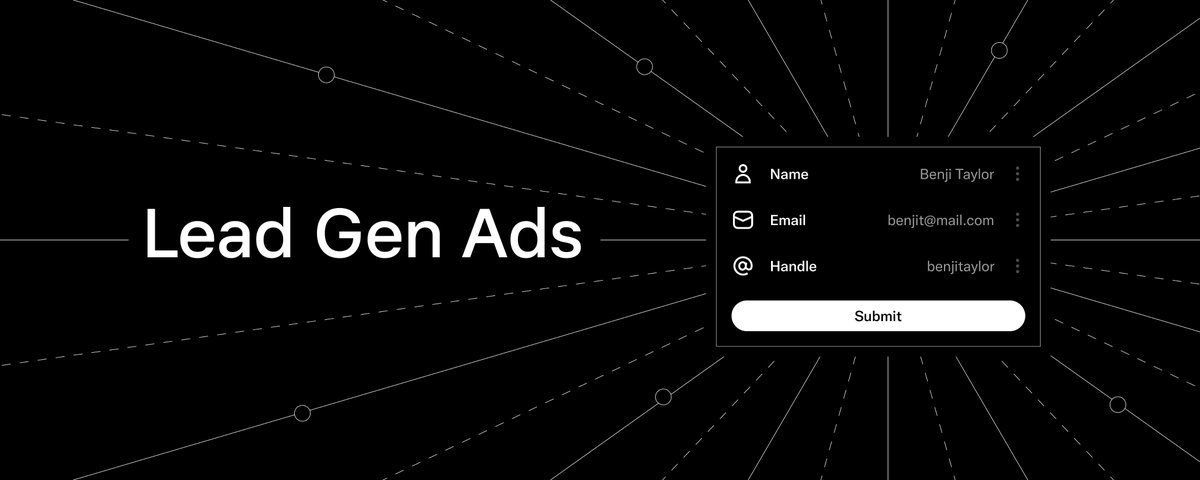
A user fills out a short form directly in X without going to a website, and the advertiser receives the lead in Leads Center and can export it or send it to a CRM.
From a Limited Launch to General Availability
X rolled out the format in several stages. On July 21, 2026, the @XBusiness account posted an announcement that a new tool was coming soon, and on August 26 the company officially introduced Lead Gen Ads.
According to the French publication La Réclame, at that stage the format went to advertisers working with X through managed service, while a gradual rollout was promised for small businesses and self-serve accounts.
In the October post, X calls the previous period a beta test and explicitly includes small and medium-sized businesses and self-serve advertisers among its users. The announcement lists no exclusions by market or advertiser category, but X also does not provide a separate list of supported countries.
For X, this is the return of a familiar tool. Twitter launched Lead Generation Cards in 2013 and opened them to all advertisers in August of the same year. In December 2016, the company announced it was shutting down the format: creation of these campaigns stopped in February 2017, and ad delivery was halted in March.
How the Native Form Works
A Lead Gen Ads ad looks like a promoted post with a prominent call-to-action button at the bottom. The color of this bar is matched to the dominant color of the image or video, so the button stands out in the feed.
After a tap, a form opens inside X, which the user fills out and submits without going to an external page. After the first submission, subsequent forms can be filled in automatically. X explains this as an effort to reduce the losses that occur with redirects, landing page loading, and re-entering data.
The company does not specify which fields are filled in automatically or whether the user sees the prefilled values before submitting.
The forms work with ads in image, video, and carousel formats, as well as with Timeline Takeover. Along with general availability, X released a localization update: form fields are now displayed in the user's language or in the language selected in the browser settings.
As a result, a single form can be used in a campaign aimed at multiple markets. X has not said whether the translation extends to questions the advertiser writes themselves or which languages are supported.
The Leads Objective, Leads Center, and Sending Leads to a CRM
Ads Manager now has a separate Leads objective for lead generation campaigns. When it is selected, the standard targeting and optimization options of Ads Manager are available, and before launch the advertiser can preview how the ad will look. Forms are created, configured, and previewed in Leads Center.
That is also where incoming leads are collected, and they can be downloaded or sent to a CRM. In its November 3 newsletter for business users, X named the available integrations with HubSpot, Salesforce, and Zapier.
As typical use cases, X lists booking demos and meetings, collecting subscribers and waitlist sign-ups, quote requests, and registrations for events and webinars. The August materials and the November newsletter also mentioned giveaways among the use cases.
How Forms Are Structured in the X Ads API
The X Ads API documentation describes the structure of a form and helps clarify what the format can do. A form must include an internal name, a description of the purpose of data collection, at least one required field, and a link to the advertiser's privacy policy with the company name.
An intro screen before the fields and a thank-you page after submission are optional, and the final page can include a button linking to the website. The documentation lists 17 standard fields:
contact details: email, phone, address, city, state or region, country, and postal code;
user information: full name, first name, last name, date of birth, company, job title, work email, work phone, gender, and X username.
Custom questions are not described in this list. Through the API, a form is attached to an ad card, after which the post with the card is promoted within a line item. Leads are exported for a selected period in JSON, CSV, or XLSX format.
Working with the Leads API requires the Campaign user permission in the ad account, and exporting leads is allowed only for account administrators, since the files contain personal data. X does not specify in the announcement whether the Leads objective is available when managing campaigns through the API.
Beta Test Results and Undisclosed Parameters
The only case study in the announcement involves micro1, a data management company that took part in the beta test.
According to X, after switching to the Leads objective, micro1's cost per lead fell by 75%, its average ROAS in the third quarter of 2026 was 5x, and the lower CPL allowed it to increase investment 4.5-fold.
At the same time, micro1's marketing director says in the same post that cost per lead in the customer acquisition program fell by 33%.
X does not explain this discrepancy and does not disclose budgets, lead volume, absolute cost per lead, or the comparison period, so the case study shows the format's potential but cannot serve as a benchmark.
Several parameters important for planning are missing from the announcement. X did not say which event the Leads objective optimizes for, whether a bid per lead can be set, or how leads are billed.
The retention period for leads in Leads Center and the mechanisms for protecting against spam and invalid leads are not specified.
Practical Implications for Advertisers
X advertisers now have a full lead generation cycle inside the platform: a dedicated campaign objective, a native form with no landing page redirect, data autofill, and exporting leads or sending them to HubSpot, Salesforce, and through Zapier.
The main change concerns small businesses and self-serve accounts, which can now use the format without the involvement of an X manager.
The format is most useful for B2B SaaS companies and performance marketing agencies that collect requests for demos, webinars, and consultations from the X audience.
There is still almost no public data on lead quality and cost per lead, and the payment terms and protection against invalid leads have not been disclosed. For this reason, the results of test campaigns should be evaluated by qualified leads in the CRM rather than by the number of submitted forms.
Sources
- X Business (@XBusiness). Lead Gen Ads Are Now Available to All Advertisers on X. October 30, 2026.
- X Business (@XBusiness). X launches Lead Gen Ads, giving advertisers instant leads where and when conversations happen. August 26, 2026.
- X Developer Platform. Lead Generation, X Ads API.
- PPC Land. X opens lead gen ads to all advertisers, 9 years after Twitter dropped them. October 31, 2026.
- Social Media Today. X launches updated Lead Gen Ads globally. November 3, 2026.
- Strategic Revenue. X Opens Lead Generation to All Advertisers: Will They Deliver Qualified Leads?. November 4, 2026.
- La Réclame. X lance ses Lead Gen Ads pour révéler les prospects dans les conversations. August 27, 2026.
Related articles

Microsoft Advertising Expands Performance Max Controls, Reporting, and AI Campaign Tools

Sendoso Expands MCP, Updates Send Flow, and Adds Handwritten Note Campaigns

ZoomInfo Connects B2B Data to Snowflake and Notion Through MCP
Meta Introduces Ads Super Burst and First Impression Ads and Expands Reels Trending Ads
Reddit Begins Testing Ads in Its Internal Search Results for Selected Advertisers

Pinterest Opens Programmatic Deals for DV360, Amazon Ads, and Yahoo DSP

Bloomreach Adds External Segments, Custom Item Types and Data Hub Contexts
Braze October 2026 Updates: AI Decisioning, Content Optimization & Integrations