Andromeda 2026: How Meta Ads Algorithms Now Deliver Our Ads
Meta Ads Symptoms Advertisers Started Seeing in 2025
If things that used to work reliably in 2025 started breaking in your Meta Ads account, leads got more expensive, proven setups stopped delivering, and campaigns began spending budget faster than you could analyze results, welcome to the club. You are in good company.
What makes it frustrating is that nothing looks different on the surface. Same Ads Manager, same buttons, same reports. But under the hood, Meta quietly changed the engine. No announcement, no email, no in-product notice in Ads Manager. In December 2024, Meta published a technical engineering post, and that was it. Meet Andromeda.
By mid 2025, the rollout was global. Advertisers who missed the shift kept losing money and blaming “the algorithm.” Advertisers who adapted have reported measurable lifts in ROAS, in some cases up to 22%.
In this article, we break it down step by step: what Andromeda is, how it works, why older approaches no longer hold up, and most importantly, what to change so you are not unintentionally funding inefficiency with wasted spend.
Table of contents
- What is Andromeda
- How Meta Ads Delivery Works with Andromeda
- Why Meta Changed the Meta Ads Delivery Engine
- How Meta Scales Andromeda
- The Practical Impact of Andromeda on Meta Ads
- Entity ID: the Mechanism That Determines Creative Uniqueness
- The Andromeda GEM Stack
- Andromeda Ready Checklist
- You Are Not Finding the Audience Anymore, You Are Feeding the Algorithm
What is Andromeda
To understand Andromeda, you first need the big picture of how ad delivery works in Meta Ads, at a fundamental level.
Imagine a nightclub. There is a bouncer at the entrance doing the door check. Inside, there is the dance floor, the bar, and the VIP area. But before you get in, the bouncer has to decide whether you are allowed through.
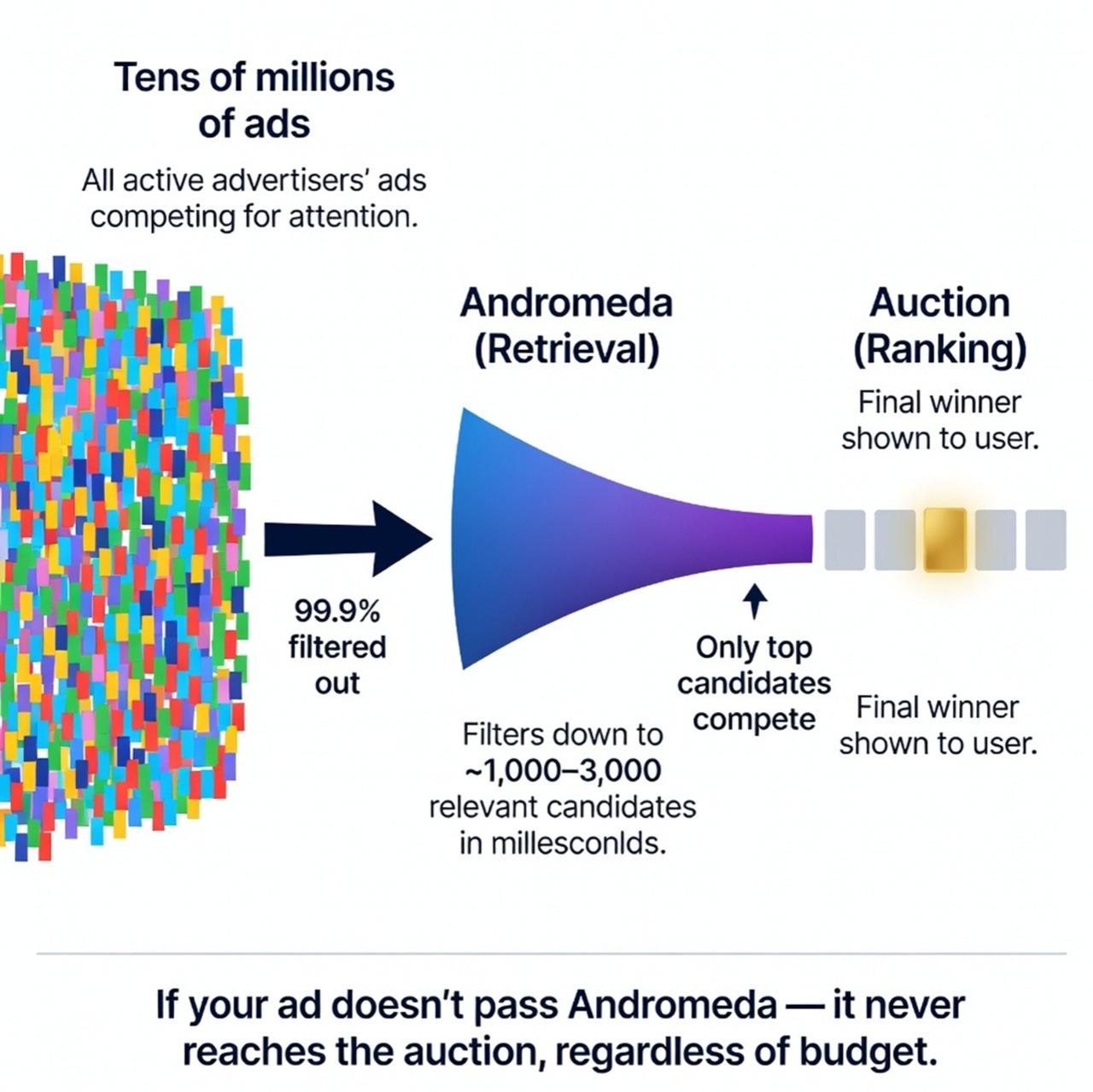
In Meta’s ad delivery system, that “bouncer” used to barely exist. Most ads effectively went straight to the dance floor, straight into the auction. Before Andromeda, Meta relied on a ranking first approach. Ads entered massive pools, and the platform tried to evaluate them all at the same time based on bids, predicted performance, and relevance. With tens of millions of active ads, that became a bottleneck. The system simply could not process everything with enough quality.
Andromeda is that bouncer. Technically, it is the retrieval stage, the first step in a two-stage ad recommendation system.
How Meta Ads Delivery Works with Andromeda
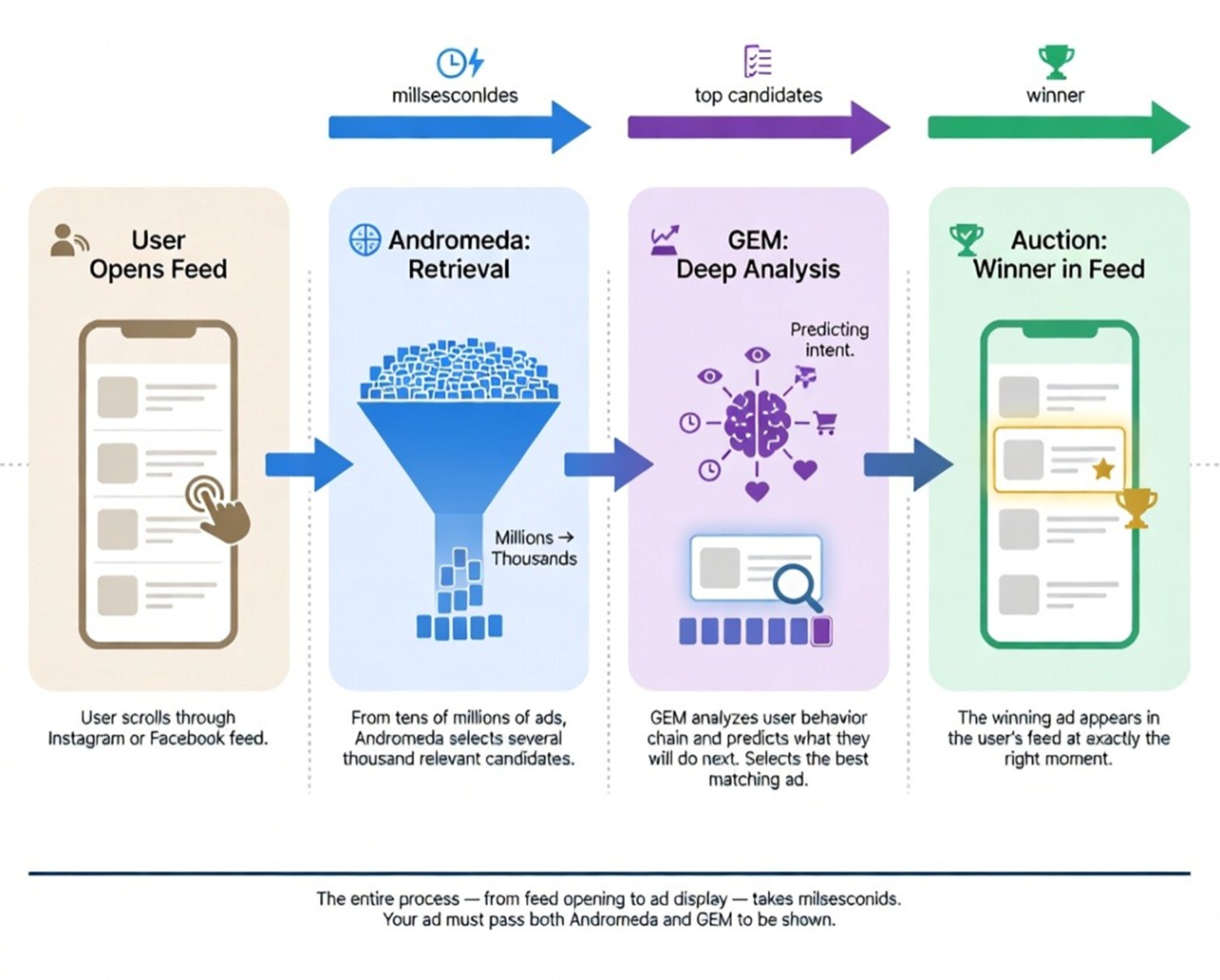
Stage 1: Retrieval (Andromeda). This is the first step in Meta’s multi-stage recommendation system. At this stage, the system narrows millions of ad candidates down to a few thousand relevant options. Andromeda evaluates signals from your creative, the user’s behavior, and the current context, and decides which ads are even eligible to enter the auction.
Stage 2: Ranking (GEM and the auction). Here the system calculates the expected value of each candidate, including eCPM, predicted CTR, conversion probability, and competitive bids, to select a winner from roughly 1,000 ads that made it through Stage 1.
The key point is simple. If your ad does not make it through retrieval, it never reaches the auction, regardless of your budget or how aggressive your bid is. You can spend as much as you want, pick what looks like the perfect audience, write a great copy, but if Andromeda decides your creative is not a strong match at that moment, your ad effectively does not exist for the auction.
Andromeda is the bouncer who decides who gets in. Ranking is what happens once you are already inside.
That is why old playbooks stopped working. Before, it was enough to compete in the auction. Now you have to earn your way into the auction first, and that is a different problem entirely.
Why Meta Changed the Meta Ads Delivery Engine
Before Andromeda, Meta’s ad selection system was simpler. It relied on separate model stages and a large set of manual heuristic rules. The system would look at targeting settings first, and only then decide which creative to show. Creative was secondary. Campaign setup was the primary control.
And that approach worked, as long as the number of ads stayed manageable.
Then the volume exploded. Dynamic Creative, Advantage+, and AI generated assets pushed advertisers to launch more variations than ever. A single Advantage+ campaign can quickly grow into thousands of creative combinations. Multiply that by millions of advertisers, and the old system simply could not keep up. Retrieval became the bottleneck.
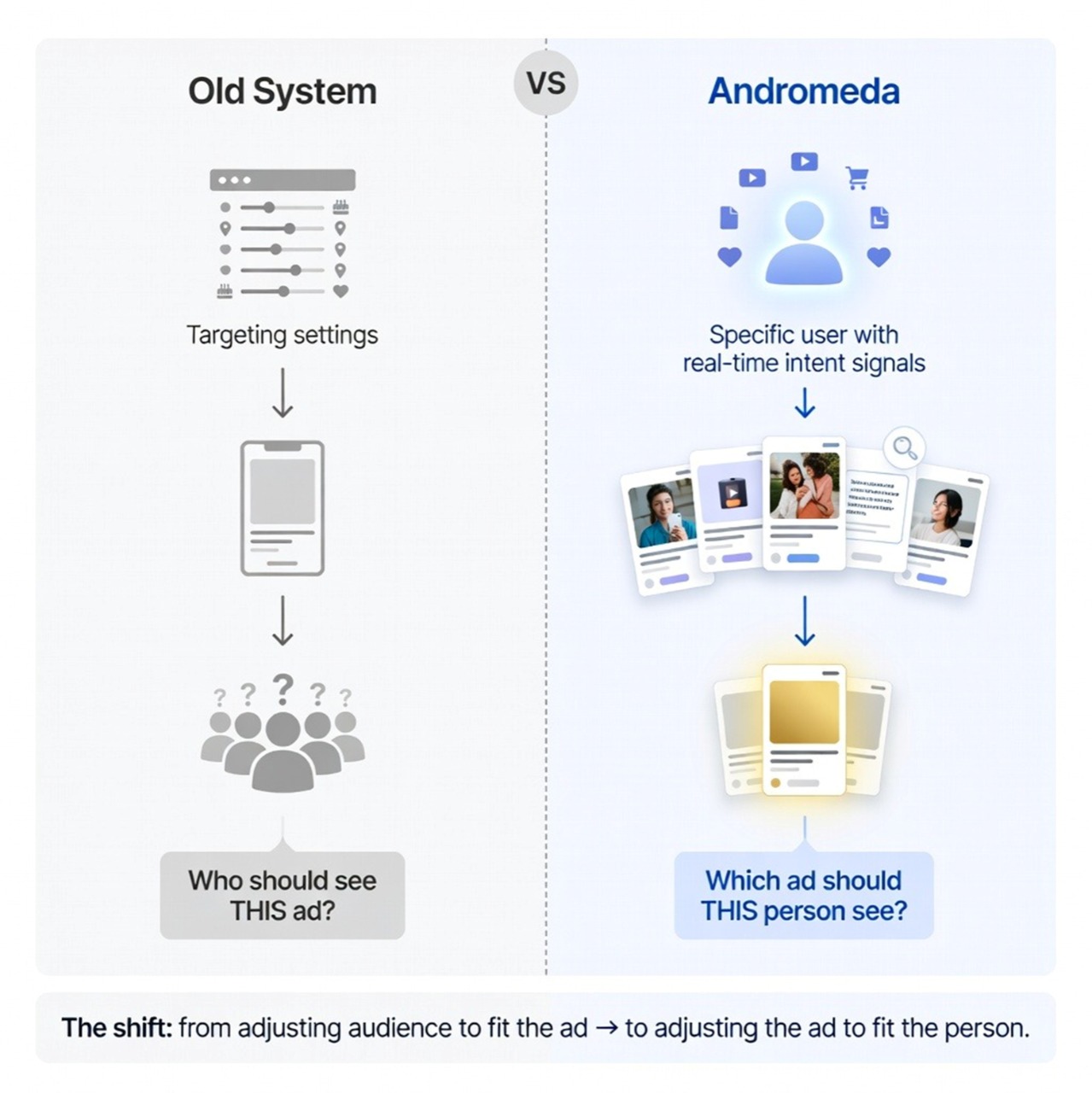
Andromeda flipped the logic. Instead of asking, “Who should see this ad?” the system now asks, “Which ad should this specific person see right now?” Before, you shaped the audience around the creative. Now the system shapes the creative selection around the person. To make that work in milliseconds across tens of millions of ads, Meta needed a completely different engine. That is how Andromeda was born.
How Meta Scales Andromeda: Hardware and Retrieval Architecture
Hardware: Andromeda runs on a combination of the NVIDIA Grace Hopper Superchip and Meta’s in-house chip, MTIA. Grace Hopper brings the CPU and GPU together on a single package, removing a major bottleneck in the older system, limited memory bandwidth. MTIA is silicon designed specifically for recommender systems. Together, this reportedly enabled a dramatic increase in model complexity, cited internally as up to 10,000x, while processing speed improved by more than 3x.
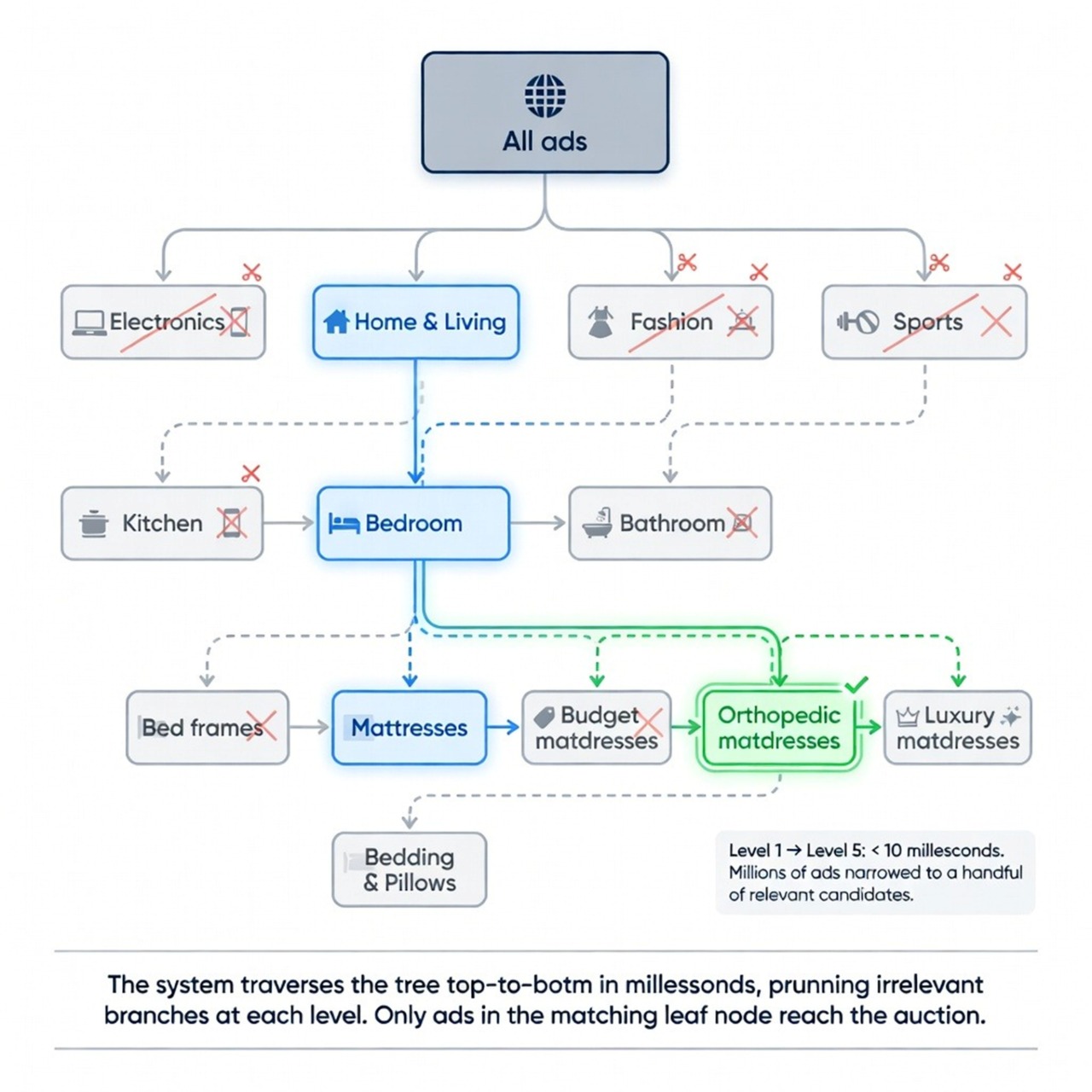
Hierarchical index: How do you evaluate tens of millions of ads in milliseconds? Andromeda organizes ads into a multi-level tree structure. The system moves from the root down through branches, filtering out irrelevant options at each step, for example: “Apparel > Women’s dresses > Summer styles > Beige linen dresses.” The index and the retrieval models are trained together, which improves both precision and recall in selection.
Model elasticity: One detail that is rarely discussed is that not every user is processed the same way. When the system identifies a user with a high probability of a high value conversion, it switches to a more complex version of the model. For lower value impressions, it uses a lighter version. This boosts inference efficiency by 10x.
What’s next: Meta plans to move the architecture toward autoregressive loss functions, an approach borrowed from large language models. The next generation of chips, according to the company, should deliver another 1,000x jump in model complexity. Andromeda is not the final version, it is the foundation of Meta’s ads AI for years to come.
The Practical Impact of Andromeda on Meta Ads Approaches and Results
Andromeda changes the game before the auction, which is why old playbooks break and new ones can unlock better efficiency.
Creative Is the New Targeting in Meta Ads
This is likely the biggest shift. In the past, the competitive edge in Meta Ads went to the advertiser who built the strongest audience setup. Now it goes to the advertiser who produces the strongest creative. In today’s Meta environment, the key question is no longer, “Who are we targeting?” It is, “What are we saying, and how many strong ways can we say it?”
But “variety” does not mean cosmetic edits. This is not about pumping out near-duplicates with minor tweaks. It is about building creatives that are meaningfully different: different messages, different visual styles, different emotional triggers. Different people on camera, different settings, different value propositions, price versus quality versus speed. Different formats, video, static, carousel. Different tones, testimonial versus demo versus educational.
Interest Targeting Is Not Required, But Still Useful
Meta recommends broad targeting, and broad has started beating many of the interest stacks that used to be reliable winners. At the same time, simplified account structures are showing better results more often.
But that does not mean you should delete interests and never look back. In real accounts, interest based ad sets can still perform at the same level as broad. Manual targeting still has a role, just in narrower, specific cases.
The most practical approach is to run both side by side and keep the version that proves itself on your account. Turning this into a belief system is a mistake.
Simpler Campaign Structures Win, But They Are Not the Only Answer
Andromeda tends to reward simplified account structures that maximize data density. When you fragment budget across dozens of campaigns and ad sets, you dilute the signals the AI needs to learn and optimize.
Meta is pushing a “one campaign, one ad set, many creatives” model, but it is not a rule. Depending on the account, alternative structures can work as well, for example:
- 1 Campaign, 1 Ad Set, 1 Creative: maximum control and clean, isolated testing for each creative.
- 1 Campaign, 1 Ad Set, up to 5 Creatives: a balance between control and enough data volume for the algorithm to learn.
- 1 Campaign, 1 Ad Set, 10 to 20+ Creatives: maximum freedom for the algorithm, and the approach Meta typically recommends.
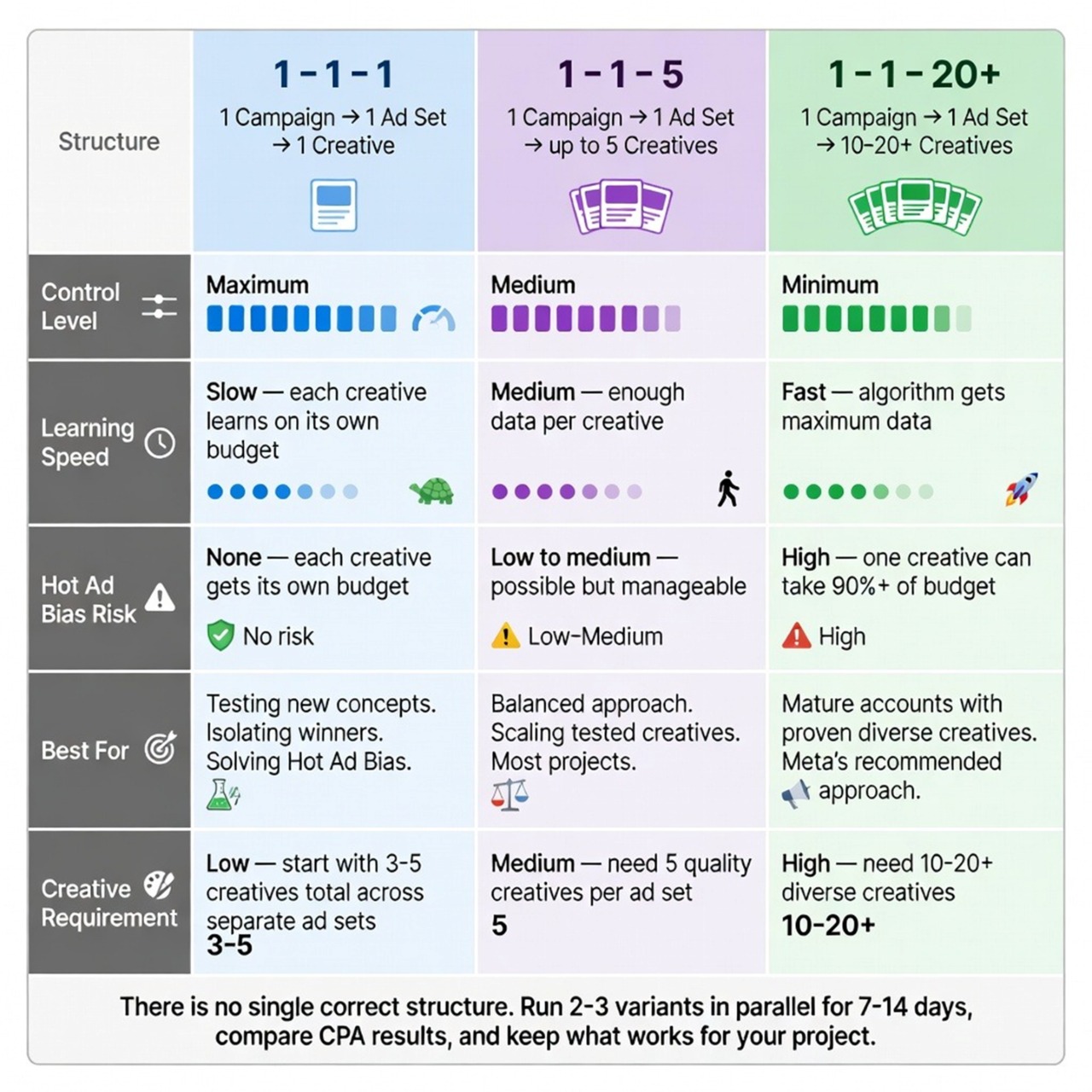
Running multiple structures at the same time helps diversify risk. Whether a given model works is not about how many ads you have, it is about how strong your creatives are. Even 50 ads do not guarantee results.
Why Advantage+ Has Become the Standard Setup
Use Advantage+ settings as the default. Placement and delivery automation are built to work with this system. In most cases, Advantage+ campaigns are the best fit. Lookalike audiences are not dead. They still matter, but they work differently now, more like signals for the system, not hard boundaries.
A 7 to 14 Day Rhythm for Creative Monitoring
This is not about blindly rotating creatives “on a schedule.” Frequent edits to ad elements reset the learning phase and can interrupt pattern recognition. Patience is a competitive advantage. Early volatility is normal and is not automatically a sign that something failed.
The point is consistent performance review. If results are stable, let the creative keep running. If metrics slip or a creative burns out, replace it or relaunch it. Treat your ads like a portfolio of assets: every 1 to 2 weeks, identify what is underperforming, cut the weak pieces, and add fresh ones.
Performance Impact: Meta Data and Practitioner Evidence
Meta reports measurable gains, including an 8% improvement in ad quality. One test showed 17% more conversions with broad targeting compared with interest based audiences. Agencies that tested a consolidated approach reported a 15% to 17% lift in conversions simply by simplifying account structure.
At Affect, we saw meaningful performance volatility while the model was stabilizing. That period affected part of our client portfolio during Q2 and Q3 2025. Today, we are seeing broad based improvement across the full portfolio.
Entity ID: the Hidden Mechanism in Meta Ads That Determines Creative Uniqueness
You hear the same advice everywhere: “Create more creative variety.” The real question is what “variety” means in algorithm terms. How does Andromeda tell the difference between two distinct creatives and two versions of one creative? The answer is Entity ID.
Entity ID Basics for Meta Ads: The Andromeda Perspective
Every time you upload an ad, Andromeda scans it. Not at a surface level, but in detail. The system analyzes the image with computer vision, what is shown, the colors, the composition, who is on screen. It analyzes the text with natural language processing, and the audio track in video with audio analysis.
Based on that analysis, the system builds a fingerprint for the ad, a set of features that captures what the ad is really about. That fingerprint is called an Entity ID. The key point is that Entity ID is assigned to meaning, not to the file itself. If two ads communicate the same idea, they can receive the same Entity ID, even if they are technically different files.
Example: How the Meta Ads Algorithm Turns 10 Ads into 1 Creative
You sell mattresses. You build 10 ads. In each one, a person is lying on a mattress in a bright bedroom, with a copy about “healthy sleep.” The only differences are the bedding color, a couple of words in the headline, and a different font. To you, that looks like 10 different creatives. To Andromeda, it is not. Same scene, same message, same visual structure. All 10 get the same Entity ID.
Here is what happens next. Those 10 ads fight for the same auction slot in front of the same audience. They do not expand reach, they get in each other’s way. CPM goes up, results do not improve, and budget gets wasted.
Example: When Andromeda Separates 4 Meta Ads into 4 Entity IDs
Same mattresses, different approach.
- The first ad is a young mom filming herself on her phone, explaining how she finally got a full night of sleep for the first time in a year. It is UGC style, close-up, natural delivery.
- The second is an infographic with a cutaway view of the mattress. Each layer is labeled, latex, foam, coil system. The focus is on engineering and materials.
- The third shows a couple in a bedroom with soft light in the morning. The headline is “Wake up without back pain.” The focus is emotion and relationships.
- The fourth is an orthopedic doctor on camera explaining why spinal support matters. It is an expert led format.
Each of these ads is different in visuals, format, message, and emotional trigger. Andromeda assigns each one a separate Entity ID. Now you have four “entries” into the auction instead of one, and each can match a different segment of the audience.
From Entity ID to Impressions: How Meta Ads Delivery Works
Andromeda organizes ads into a tree structure, where each Entity ID has its own place. When a user opens the feed, the system moves through that tree from the top down and prunes branches that do not match the user’s behavior and signals.
For example, imagine a user has been looking up back pain content over the past week. The system may cut off the “bedroom design” branch, while keeping branches like “spine health” and “sleep quality reviews.” If all of your ads sit in a single branch and that branch gets pruned, you simply do not make it into the auction. If your ads are spread across different branches, at least some of them can still enter the auction.
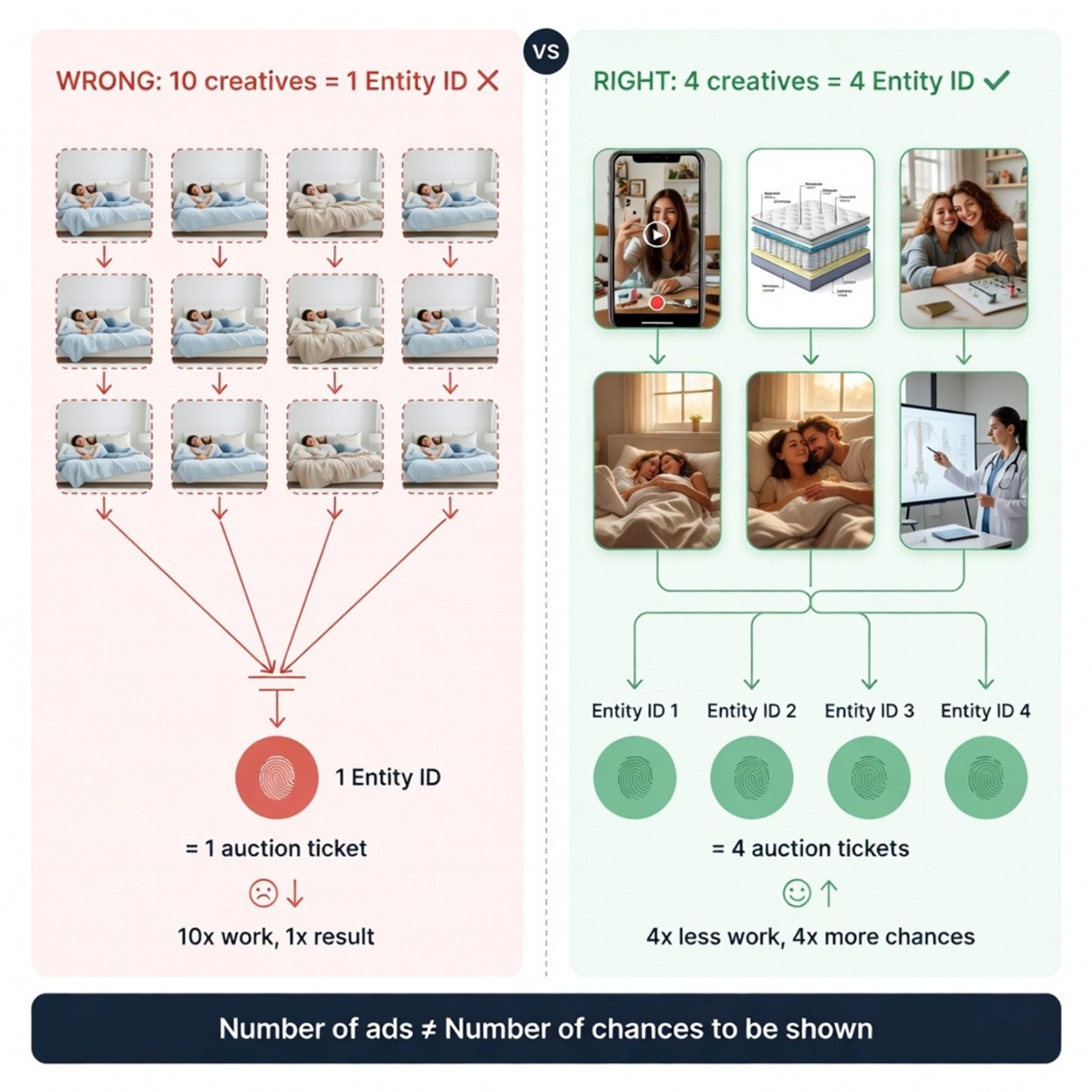
Simple math: 12 ads with 12 different Entity IDs across four branches will generate more delivery opportunities than 50 ads with one Entity ID trapped in a single branch.
Andromeda Penalties: What Happens When Creatives Look the Same
Andromeda does not just ignore duplicates, it penalizes them. The more similar ads you upload, the harsher the consequences.
First you see higher CPM and cannibalization, similar ads steal impressions from each other. Then you get training confusion. The system blends performance data across near-duplicates, but cannot clearly learn which elements drove results and which did not. Learning slows down, and optimization starts to stall.
How to Track Entity ID Signals in Meta Ads
Meta has started adding new metrics in Ads Manager that are directly tied to how Andromeda operates. They are not available in every account yet, but they are worth understanding now:
- Creative Similarity: an estimate of how similar your ads are within the same ad set. If the score is high, Andromeda is likely grouping them under the same Entity ID, which means they compete with each other instead of expanding reach.
- Creative Fatigue: a burnout indicator. It signals that the same creative has been shown too many times to the same people, and performance is starting to decline.
- Top Creative Themes: a breakdown of which creative types receive the most budget. For example, you might see 80% of spend going to testimonial ads while product demo ads barely deliver. That is a signal to either add more variety or rebuild the weaker creative angles.
Our Buying Team’s Key Takeaway
The rules of the game have changed. The new competitive edge is built around quality, not quantity. No more thousands of copies and minor variations of the same message. Now the goal is dozens of better-developed messages and stronger executions.
Do not chase the number of ads. Chase the number of unique Entity IDs. Ten ads built around ten distinct concepts will deliver more than fifty variations of the same idea.
The Andromeda GEM Stack: How Meta Ads Chooses What Gets Shown
Andromeda handles the first half of the job by selecting which ads can enter the auction. The final decision, which ad a person sees, is driven by GEM, the Generative Ads Recommendation Model.
What GEM Is in the Meta Ads Algorithm
GEM is a recommendation model Meta introduced in November 2025. Meta describes it as the central brain of its advertising system. In terms of scale, it is closer to large language models like ChatGPT than to traditional ad algorithms.
If Andromeda is the entrance filter, GEM is the brain that makes the final decision on which ad to show a specific person right now.
How GEM Works Together With Andromeda in Meta Ads
First, Andromeda filters tens of millions of active ads in milliseconds and selects a few thousand candidates that could be relevant for this person. It is a rough cut, but it is fast.
Second, those candidates are passed to GEM for deeper evaluation. The model estimates the likelihood that the user will click, watch the video through, visit the site, and purchase. GEM looks beyond the ad itself and factors in the full sequence of the user’s behavior.
Third, the auction runs among the finalists, and the winning ad is delivered in the feed.
Intent Over Interests: How GEM Thinks About Users
This is a fundamental shift in logic. The old system leaned on interests. If a user follows fitness pages, show them gym ads. It is a static model: the system labels who you “are” and ties ads to that label.
GEM works differently. It analyzes sequences of actions, what a user watched, what they paused on, what they skipped, what they clicked into. Based on that chain, it predicts what the user is likely to do next.
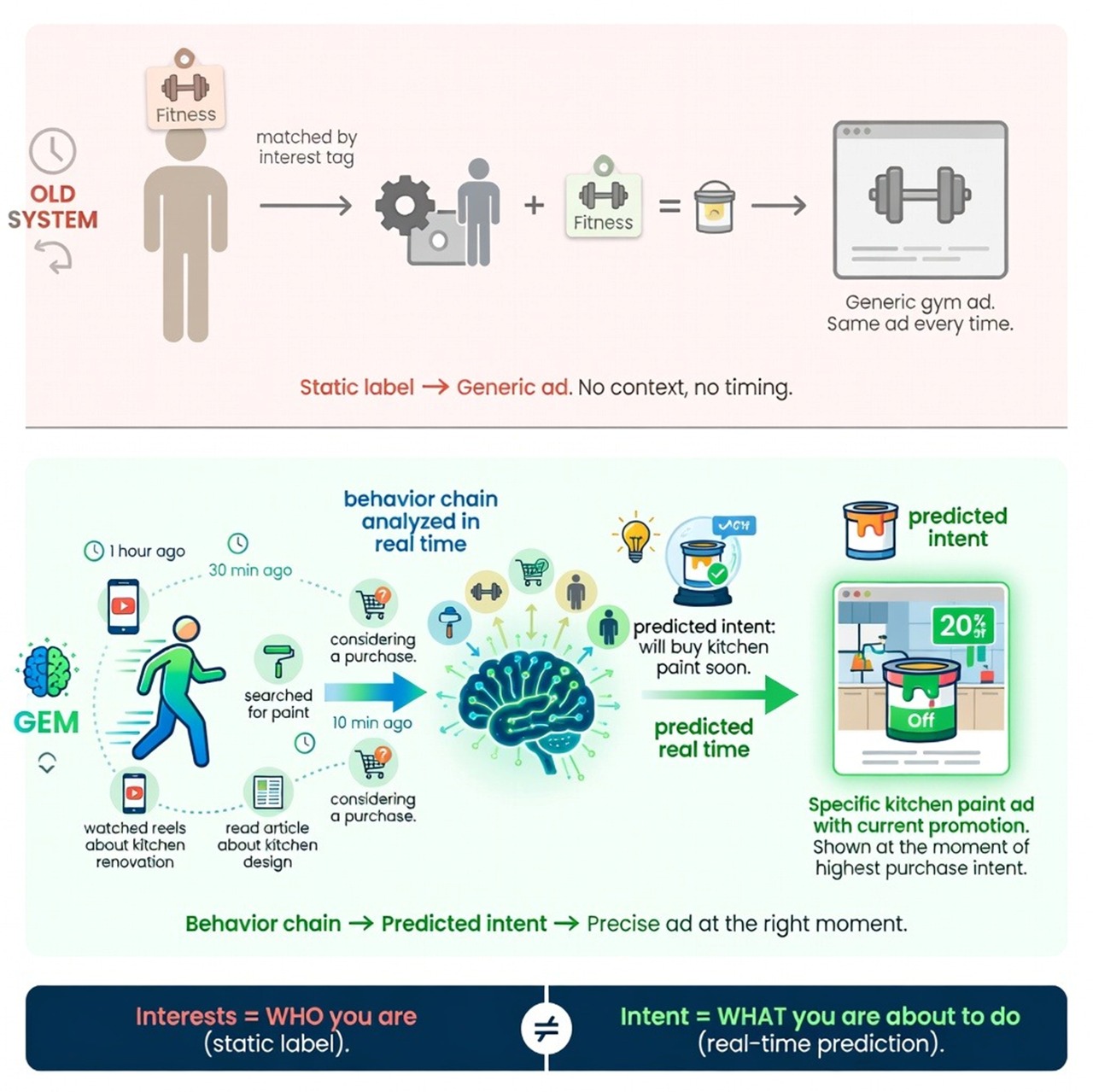
For example, in the last hour a user watched three Reels about kitchen remodeling, lingered on a post about choosing paint, and clicked into an article about small kitchen design.
Old logic: “interest equals home improvement,” so show an ad for a hardware store.
GEM: “this user is actively choosing kitchen materials, the likelihood of buying paint in the next 48 hours is high,” so show an ad for a specific kitchen paint brand with a promotion.
The difference is between a label, “who you are,” and a prediction, “what you will do next.” GEM optimizes around real-time intent.
Inside GEM: The Building Blocks of Meta’s Model
GEM brings together several technologies that used to operate separately.
Sequence modeling: The model reads user behavior as a chain, not as isolated actions. “Viewed a product, read reviews, added to cart” is one signal. “Viewed a product, closed the page” is a very different signal. For GEM, the order of actions matters the way word order matters in a sentence.
Multi-task learning: One model learns to predict multiple outcomes at once, clicks, video views, purchases, and even value or cost. In the past, each objective often had its own model, and those models could work against each other.
Generative scoring: GEM does not just pick the best ad from a fixed list. It generates a score for each pairing of “this user plus this ad.” It is similar to how a language model predicts the next word: the system estimates the most likely outcome for each possible combination.
Three Practical Takeaways for Meta Ads Advertisers
First, conversion data is now mission-critical. GEM learns from real user actions. The more accurately you send signals through the Pixel and Conversions API, purchases, leads, calls, the better the model understands who your customer is and when they are ready to buy.
Second, the learning phase matters more than ever. GEM needs sequences of behavior to predict intent reliably. Constant campaign restarts, frequent objective changes, and budget fragmentation all make it harder for the model to learn.
Finally, do not try to outsmart the algorithm with overly narrow targeting. GEM sees more of your customer’s behavior than you do. Your job is to feed the system strong creatives and clean conversion signals. The model will handle audience allocation.
Andromeda Ready Checklist: What to Change in Meta Ads Today
That is enough theory. Here are concrete steps you can roll out immediately, based on approaches we have validated across campaigns and accounts.
Creative Variety: Concepts, Not Tweaks
After everything we covered about Entity ID, the core rule is simple: every new ad should differ from the others by the idea, not by the button color.
Before you build a new creative, ask three questions. Is the message different? Is the visual execution different? Is the format different? If the answer is “no” to at least two of the three, Andromeda will likely group it with an existing ad under the same Entity ID.
A practical framework for generating creatives that are truly different is PDA: Persona, Desire, Awareness.
- Persona: Who is this ad for? Not “women 25 to 45,” but a specific archetype. A young mom who is running on no sleep. A man over 40 dealing with back pain. A student who is trying to save on everything. Each persona should have its own creative and its own message.
- Desire: What problem are you solving, or what desire are you fulfilling? The same mattress can be sold through “better sleep,” “relief from back pain,” “a more stylish bedroom,” or “saving money on doctor visits.” Each desire is a different angle.
- Awareness: Where is the person in the decision process? Someone who just started thinking about a new mattress and someone actively comparing models are not the same buyer. The first needs content that frames the problem. The second needs comparisons, reviews, and a concrete offer with pricing.
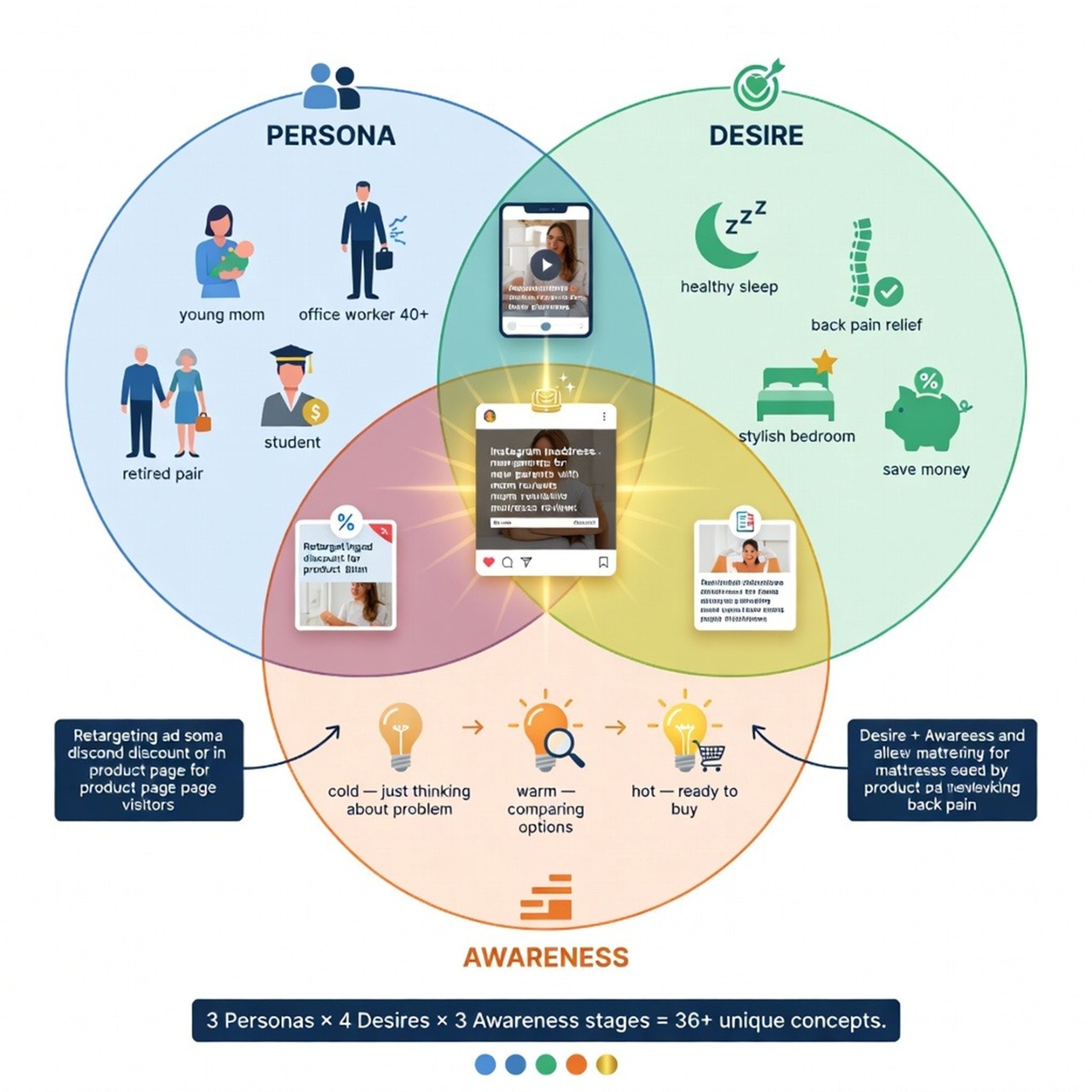
When you combine these three axes, you can generate dozens of unique concepts, and each has a strong chance of earning a separate Entity ID.
Structure Testing: Find What Holds Up
Do not blindly copy someone else’s account structure. Run two or three variants in parallel, then compare results after 7 to 14 days.
- Option A: 1 campaign, 1 ad set, 1 creative. Maximum control. You can clearly see which creative drives which result. Best for testing new concepts and addressing Hot Ad Bias.
- Option B: 1 campaign, 1 ad set, up to 5 creatives. A balance of control and data volume. The algorithm has enough options to optimize, and you can still see what is working.
- Option C: 1 campaign, 1 ad set, 10 to 20+ creatives. Maximum freedom for the algorithm. This is the approach Meta typically recommends. It works best when you already have proven creatives built around different concepts.
There is no single “correct” structure. The right one is the one that performs on your account.
Compare Broad and Interest Targeting
Run two ad sets with the same creatives: one broad with no interests, and one built on interest targeting. Give both the same budget and the same time window. After 7 to 14 days, compare CPA and lead quality. In some accounts, broad wins. In others, interests perform just as well. The only way to know is to test.
Conversion Data: The Foundation
Andromeda and GEM learn from real user actions. The more accurately you pass conversion data, the better the algorithm performs. At a minimum:
- Pixel: Installed and correctly tracking your core events, page view, add to cart, begin checkout, and purchase (or lead and call events, depending on the business).
- Conversions API (CAPI): Server-side event delivery that mirrors Pixel signals. It protects tracking against ad blockers and iOS limitations. Without CAPI, you lose data and the algorithm learns from an incomplete picture.
- Offline conversions (if you have a CRM): Send offline outcomes back to Meta. This helps GEM understand which leads became customers, not just which ones submitted a form.
Performance Checks That Matter
Every 7 to 14 days, review four things:
- CPA: Is your cost per desired action rising, or holding steady?
- Frequency: How often the same people are seeing the ad. If it goes above 3 to 4, the creative is likely repeating to the same audience.
- First Time Impression Ratio: If this drops, you are running out of fresh audience.
- Creative spend distribution: If one creative takes 90% of spend while the rest get scraps, you are seeing Hot Ad Bias.
If performance is stable, do not touch it. Frequent changes reset the learning phase. With Andromeda, patience can be as much of a competitive advantage as a strong creative.
Give Andromeda Room to Work
This may be the hardest point in practice. Andromeda and GEM perform better when you give them room to work. Specifically, do not narrow the audience without a clear reason, do not split the budget across dozens of campaigns, do not change campaign settings every day, and do not shut ads off after the first 24 hours of weak results.
Your role is shifting from “ad setup operator” to “supplier of high-quality inputs.” You own the creatives, the data, and the strategy. The algorithm handles allocation, optimization, and audience discovery.
You Are Not Finding the Audience Anymore, You Are Feeding the Algorithm
Andromeda is not just another “algorithm update” where you tweak a few settings and move on. It is a fundamental rebuild of how Meta decides which ad to show to which person.
In the old model, the workflow was straightforward. You defined the audience, uploaded the creative, set the budget, and the system delivered ads within the boundaries you set. Your advantage as an advertiser came from defining those boundaries as precisely as possible.
Now the logic is flipped. Andromeda decides who is eligible to see your ads. GEM predicts user intent in real time. Entity ID determines how many “entries” your ads get into the auction. Model elasticity controls how much compute Meta is willing to spend on each impression.
Your edge now comes from different skills:
- Creative: Not more ads, but more distinct concepts. Ten ads built around ten different ideas will beat fifty variations of one idea.
- Data: The more accurately you send conversion signals through Pixel, CAPI, and offline events, the smarter the system gets on your account.
- Patience: A stable learning phase, consistent structure, and no panic during early metric swings. This is not passivity, it is deliberate strategy.
- Monitoring: Regular reviews of CPA, frequency, spend distribution, and creative freshness. Not scheduled rotation, but targeted, data-driven decisions.
Teams that keep running the old playbook, slicing audiences into micro segments, pumping out lookalike creatives, changing settings every day, will keep paying more for worse results. Not because they are bad marketers, but because the system changed and their approach did not.
Teams that understand the new rules and adapt are already seeing the upside: lower CPA, higher conversions, and more stable scaling.
Andromeda is not the end state. Meta is already building the next generation of chips and models. The system will only get smarter and faster. But the principle behind it will hold: the algorithm finds the audience, and you feed it high-quality inputs.
The sooner you accept that shift, the less expensive the transition will be.
Related articles

Nevada Facebook and Instagram Audience in Meta Ads: 2026 Reach and Key Segments
Louisiana Facebook and Instagram Audience in Meta Ads: 2026 Reach and Segments
Arizona Facebook & Instagram Audience: Total Meta Ads Reach, Capacity, and Targeting Segments
California Meta Ads Reach 2026
Colorado Meta Ads Audience: Facebook & Instagram Reach, Capacity, and Targeting Segments