
HubSpot UNBOUND 2026: Customer Lifecycle Marketing and AI
From September 16 to 18, 2026, HubSpot held UNBOUND 2026 in Boston. Formerly known as INBOUND, the annual conference brought together more than 200 sessions covering marketing, sales, CRM, analytics, and artificial intelligence.
The defining theme of the event was a change in how HubSpot approaches marketing. The company is gradually moving from the Inbound Marketing concept toward a unified model of Customer Lifecycle Management. Audience acquisition, demand generation, sales, customer service, and retention are viewed as interconnected processes.
This shift explains not only the conference's new name but also the direction of HubSpot's products. CRM is becoming the infrastructure through which AI agents can analyze information, participate in workflows, and carry out actions.
In this article
From Inbound Marketing to Customer Lifecycle Management
The Inbound Marketing concept, which HubSpot has championed since its founding, is built around attracting prospective buyers with useful content. Instead of relying on intrusive advertising, businesses create materials that answer audience questions, help people evaluate products, and build trust in the brand.
Historically, this approach has been closely associated with SEO, blogs, educational content, lead generation forms, email marketing, and subsequent management of contacts in a CRM.
However, consumer behavior and marketing technology have changed. A buyer may discover a product through social media, research it through AI-powered search, receive a recommendation in a community, visit the website, and contact sales only after several additional interactions.
The relationship does not end with the purchase. The company continues to manage repeat orders, subscriptions, service, upselling, and retention.
Marketing therefore cannot be viewed exclusively as attracting a new visitor and converting that visitor into a lead. The transition from INBOUND to UNBOUND reflects an expansion of the original model: business growth now involves marketing, sales, service, and operations throughout the customer journey.
The Customer Lifecycle encompasses awareness and demand generation, lead acquisition, lead nurturing, sales and conversion, customer service, and retention and expansion. These stages were not invented by HubSpot. The change in the company's strategy is its ambition to bring them together within a single system of data and automated actions.
| Customer lifecycle stage | Business objective | Role of the platform |
|---|---|---|
| Awareness & Demand Generation | Build awareness and demand | Content, campaigns, AI search, and marketing channels |
| Lead Acquisition | Convert interest into identifiable prospects | Forms, landing pages, and CRM records |
| Lead Nurturing | Develop interest and qualify prospects | Segmentation, automation, and AI agents |
| Sales & Conversion | Manage opportunities and close deals | Sales Hub, CRM, and deal intelligence |
| Customer Service | Resolve problems and support customers | Service Hub and service automation |
| Retention & Expansion | Increase repeat purchases and customer value | Customer data, personalization, and lifecycle workflows |
The Outcomes Era: Why HubSpot Wants AI to Be Measured by Business Results
At the opening of UNBOUND 2026, HubSpot CEO Yamini Rangan presented the concept of the Outcomes Era.
The central idea is to move beyond experimenting with individual AI tools and start using artificial intelligence to achieve measurable results. The number of generated assets, prompts, or automations created is not, by itself, a measure of successful AI adoption.
What matters is whether the technology helps generate qualified demand, increase the number of sales opportunities, close deals, and serve customers more effectively.
Rangan emphasized that the spread of AI lowers the technical barrier to creating solutions while increasing the importance of strategic thinking and human judgment. An employee defines the business objective, while AI uses customer information, company context, and available tools to help accomplish it.
For example, instead of asking AI to write five emails, a marketer might set a goal of increasing the percentage of leads that become sales opportunities. To support that goal, the system would need to analyze lead sources, interaction history, campaign performance, and CRM data, then help create appropriate segments and communications.
Final decisions, constraints, and success criteria remain the company's responsibility. In the Outcomes Era, AI is not merely a content generator. It becomes part of the infrastructure for managing commercial processes.
Major Product Announcements at UNBOUND 2026
On September 16, during Fall 2026 Spotlight, HubSpot presented developments in the infrastructure connecting customer information, business context, AI agents, and tools for marketing, sales, and service.
Self-Updating Smart CRM
Traditional CRM systems require employees to update records continuously. Sales representatives log calls, meeting outcomes, changes in deal status, and customer information. When this data is incomplete, reporting, segmentation, and automation are affected.
HubSpot introduced Self-Updating Smart CRM, which uses available information from calls, emails, and meetings to update records automatically and reduce dependence on manual data entry.
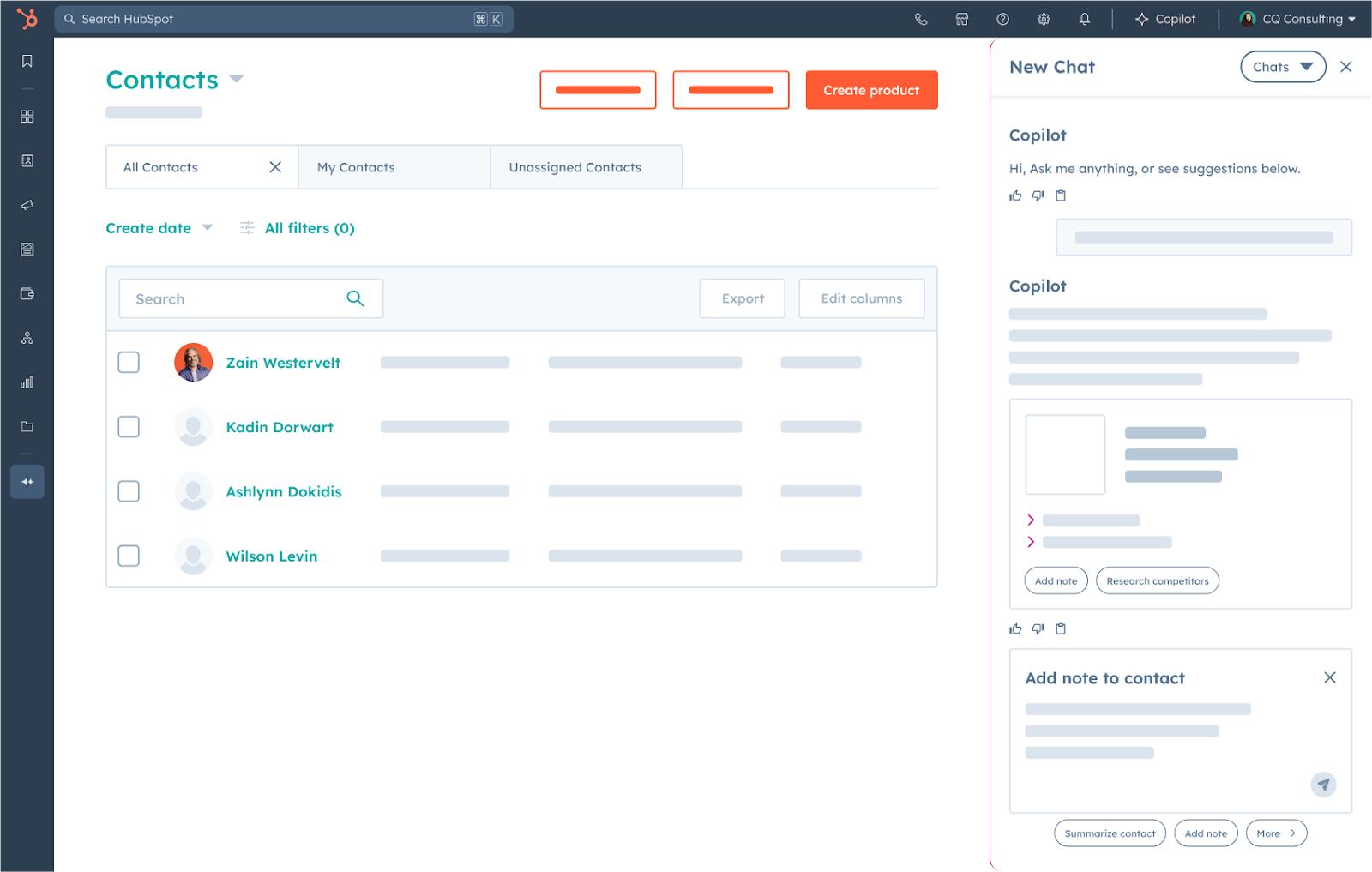
For marketing teams, CRM data quality affects segmentation, lead scoring, suppression of existing customers from advertising audiences, and the transmission of conversion signals to advertising platforms.
Automated updates do not eliminate the need to verify accuracy. Ambiguous contact matching, incomplete interaction histories, and interpretation errors remain possible.
Growth Context and Context Home
Growth Context describes the information AI systems need to understand a business: customer data, brand characteristics, target audiences, operational processes, and interaction history.
Context Home provides a place for businesses to review and correct information that HubSpot uses to understand their operations.
For example, an agent preparing an email campaign should account for more than a product description. It also needs brand guidelines, previous communications, purchases, and the contact's current status in the CRM.
If that context is incomplete, AI may generate communications that are technically correct but commercially inappropriate. HubSpot positions Growth Context as an important foundation for AI-powered automation.
Breeze Assistant: From Answers to Actions
The redesigned Breeze Assistant is positioned as a unified interface for assigning tasks and coordinating specialized AI agents.
Instead of configuring every tool separately, an employee describes a task in everyday language, and the system connects available CRM data with supported operations.
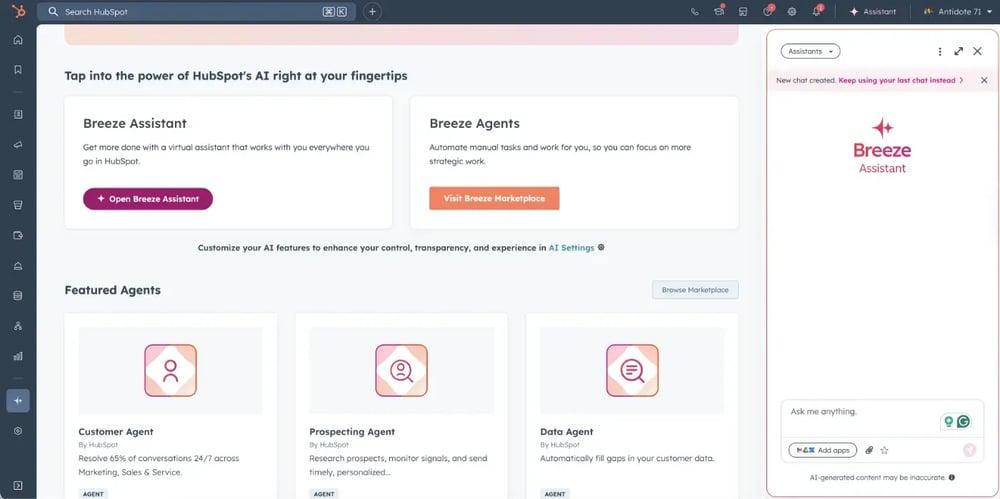
For instance, a marketer could ask the assistant to prepare a re-engagement campaign for customers who have not purchased recently. The assistant can help identify the audience, create materials, and organize the communication sequence.
The central idea is a move from generating isolated answers to completing processes within the permissions granted to the system.
Marketing Studio
Marketing Studio was presented as a unified workspace for data analysis, campaign planning, content preparation, and collaboration across marketing teams.
The platform aims to reduce the need to switch continuously between analytics tools, content editors, CRM, and email marketing applications.
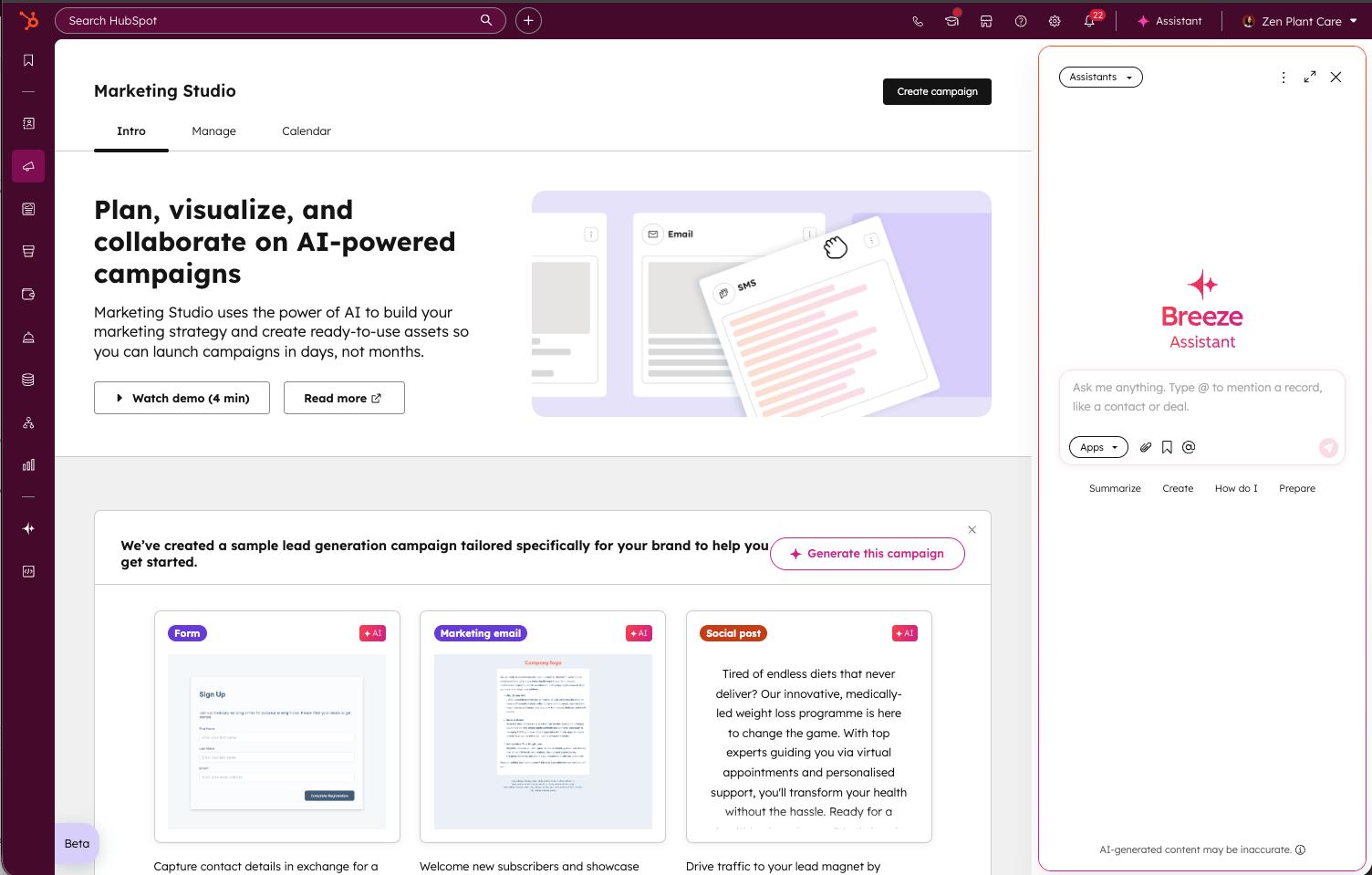
HubSpot demonstrated how Breeze Assistant, Campaign Agent, and Content Agent can work together on marketing campaigns.
Marketing Studio therefore expresses the idea of Customer Lifecycle Management: a marketing platform should not only create demand but also use accumulated data to develop customer relationships.
It is important to note that announced capabilities may be at different stages of availability and may depend on a company's subscription and account configuration.
AI Agents as the Foundation of a New Marketing Infrastructure
HubSpot co-founder Dharmesh Shah delivered a presentation titled Growing Better in the Age of the Builder.
Its central idea was that AI reduces the distance between a business idea and a working solution. In the past, creating a specialized internal tool often required developers, a separate budget, and a lengthy implementation process. AI can now simplify prototyping and the creation of workflows.
However, the main constraint is increasingly not access to a model but the ability to define the problem correctly and give the system the context it needs.
For marketers, designing processes is becoming a more important skill, alongside the ability to use ready-made software features.
HubSpot is developing this vision through Agent Hub and Agent Builder, which allow teams to use specialized agents and create custom scenarios based on CRM data.
This points to a shift from individual workflows built entirely around predefined rules to more complex AI-assisted actions performed within established permissions.
But AI agents do not mean fully autonomous marketing. Access controls, quality assurance, and human oversight remain necessary when working with customer data, external communications, and commercial decisions.
What HubSpot's Strategy Means for Performance Marketing
HubSpot's new tools do not change the algorithms of Google Ads, Meta Ads, or LinkedIn Ads. They can, however, improve the processes that influence the effectiveness of paid customer acquisition.
Lead qualification. An up-to-date CRM allows teams to measure more than inquiries and cost per lead. They can also assess qualified leads, pipeline, and actual revenue.
Audiences. Unified customer data makes it easier to distinguish new buyers, existing customers, inactive accounts, and re-engagement segments. These audiences can be used in supported advertising integrations, subject to privacy requirements.
Customer nurturing. AI agents can help create communications based on customer interests, interaction history, and lifecycle stage.
Attribution and reporting. Combining advertising and CRM data can help teams examine the relationship between spending, lead quality, deals, and revenue.
AI does not automatically resolve measurement errors, missing customer data, or attribution limitations. Its value depends on accurate event transmission, clear qualification rules, and measurable business objectives.
Conclusion: From Campaign Automation to Commercial Outcomes
UNBOUND 2026 marked a change in HubSpot's positioning. The company, previously known primarily as an advocate of Inbound Marketing, wants to become an infrastructure platform for managing the entire customer lifecycle.
The new model brings together CRM, marketing, sales, service, business data, and AI agents. AI is no longer viewed solely as a way to increase employee productivity but also as a mechanism for connecting information with action.
For the industry, this reflects a broader shift: competitiveness increasingly depends on the ability to connect marketing activity with customer information and measurable business results.
UNBOUND nevertheless demonstrated HubSpot's strategic direction, not a universally proven performance benefit for every new product. Actual advantages must be validated through implementations.
The ultimate measures remain customer quality, cost of sales, revenue, retention, and long-term customer value. The move from automating individual marketing operations to managing the full customer lifecycle is the most significant takeaway from UNBOUND 2026.
Affect Group · Integrated Performance Marketing
Connect Paid Media and Direct Marketing to Real Business Outcomes
Entrust the integration of your Performance Marketing and Direct Marketing activities to Affect Group. We build and optimize campaigns across Google Ads, Meta Ads, and LinkedIn Ads, connecting audience acquisition with CRM data, lead nurturing, and customer lifecycle strategies. Our focus is not simply generating contacts. It is helping your marketing deliver qualified opportunities, revenue, and measurable business growth.
Request a Free Marketing AuditReview your paid media, CRM signals, and lifecycle marketing together.